Charger healthCP-4471 · Croydon Retail Park
Failure predicted6 days
warning before it fails
0 h
unplanned downtime
R-One predicts charger failures up to 3 weeks in advance, with up to 97% accuracy, and prescribes the fix before a driver finds the fault. Around it sits the full asset lifecycle: inventory, installation, maintenance and fault analytics on one record.
Operators




Downtime starts long before the fault: at handover, in the asset record, in weeks of wear nobody sees. Iris R-One is EV charger asset management software that closes each of those gaps on one record.
In the record
Nobody can say which firmware or contactor a charger has. Changes made on site never reach the record.
Inventory managementAt handover
Stations go live without voltage readings, photos or an OCPP connectivity test.
Installation managementWeeks before
A contactor degrades for weeks. Nothing flags it, and nothing says what to do about it.
Predictive & prescriptiveOn the day
The CMS still shows Available. Drivers find the fault first.
Fault analyticsThe repair
The technician arrives without the right part and has to come back.
Maintenance managementR-One ranks every charger by the asset health index, forecasts which component will fail and when, and prescribes the fix as a remote action or a work order. Of the chargers it predicted would fail, up to 97% actually did.
Of 100 chargers R-One predicted would fail
Built on ISO 55000 asset management principles. The asset record forms the foundation, maintenance completes the work, and intelligence decides what needs attention next and what to do about it. Every outcome writes back to the same record.
Set up assets
Register every charger, component, spare part and warranty on one record, kept current from the field.
Move every station from site survey to commissioned handover, with evidence captured on the phone.
Maintain assets
Reactive repairs and preventive schedules on one work engine, closed out from the mobile app.
Asset intelligence
Find logged and derived faults, and the root cause behind them.
Predict charger failures up to 3 weeks in advance, with up to 97% accuracy, then act on the prescribed fix before failure.
Closed loop: every outcome, including field work from the mobile app, updates the asset record
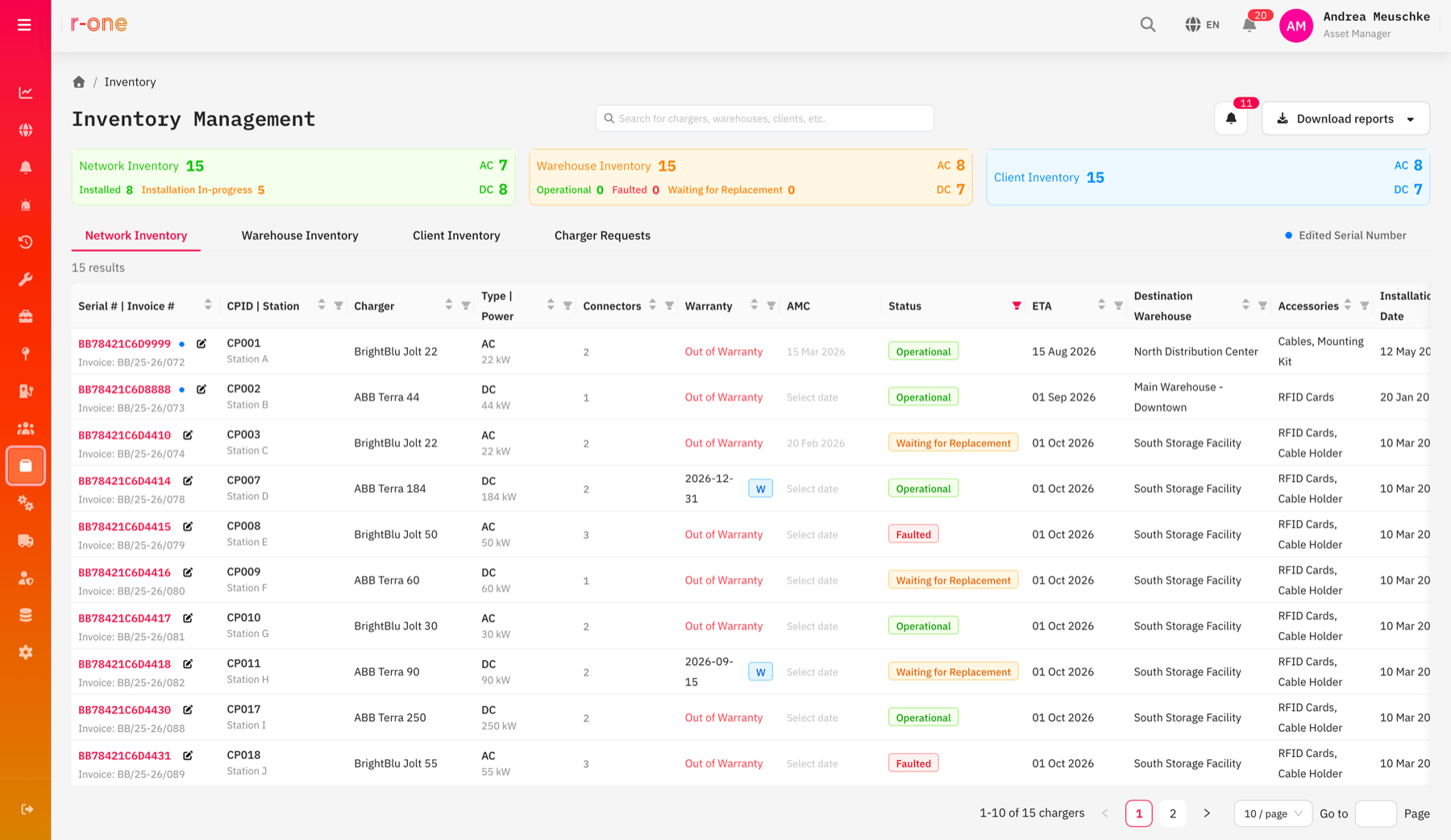
The record everything else depends on.
In the mobile appTechnicians read and update the record on the phone, with photos and readings attached to the asset on site.
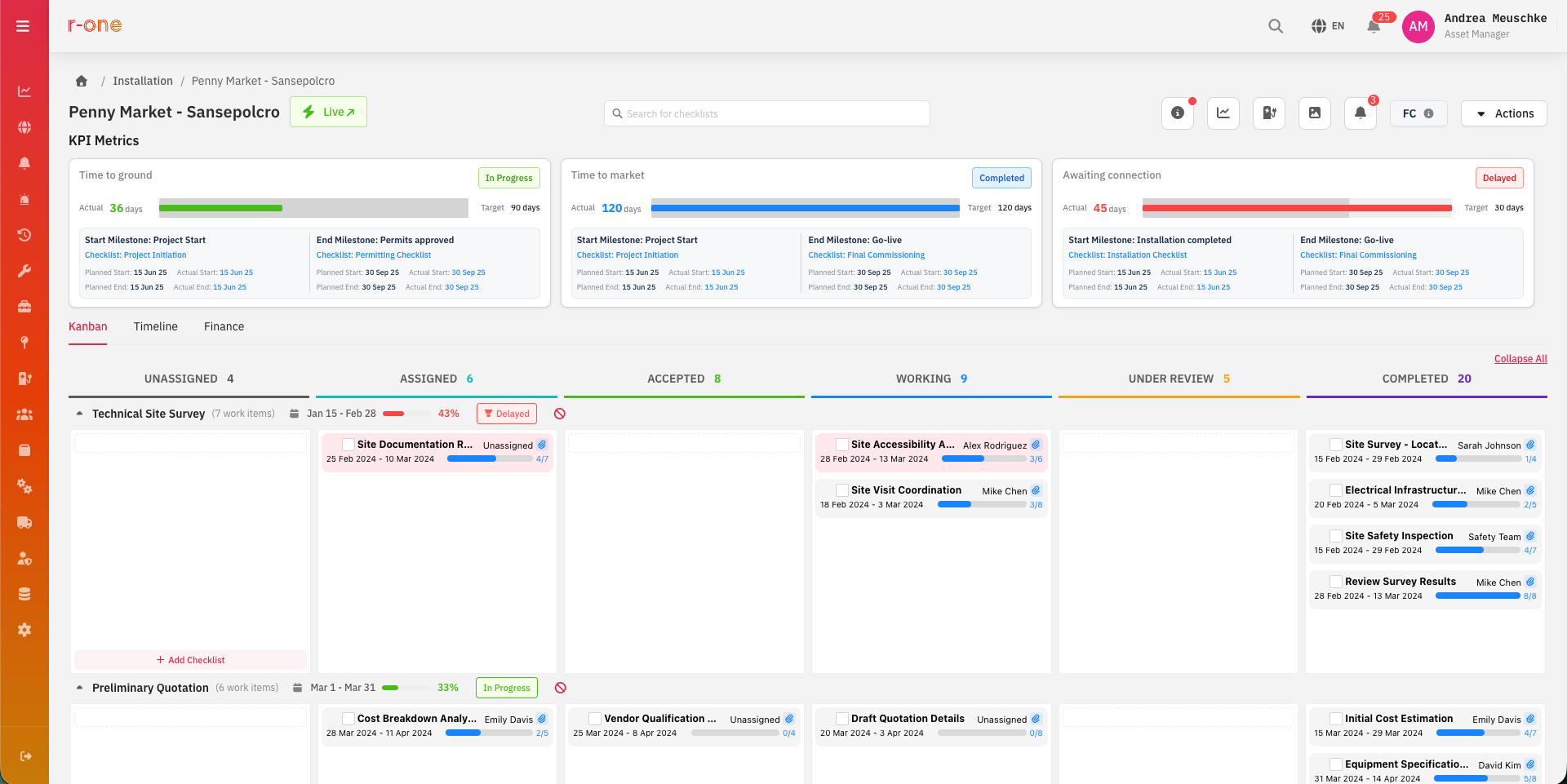
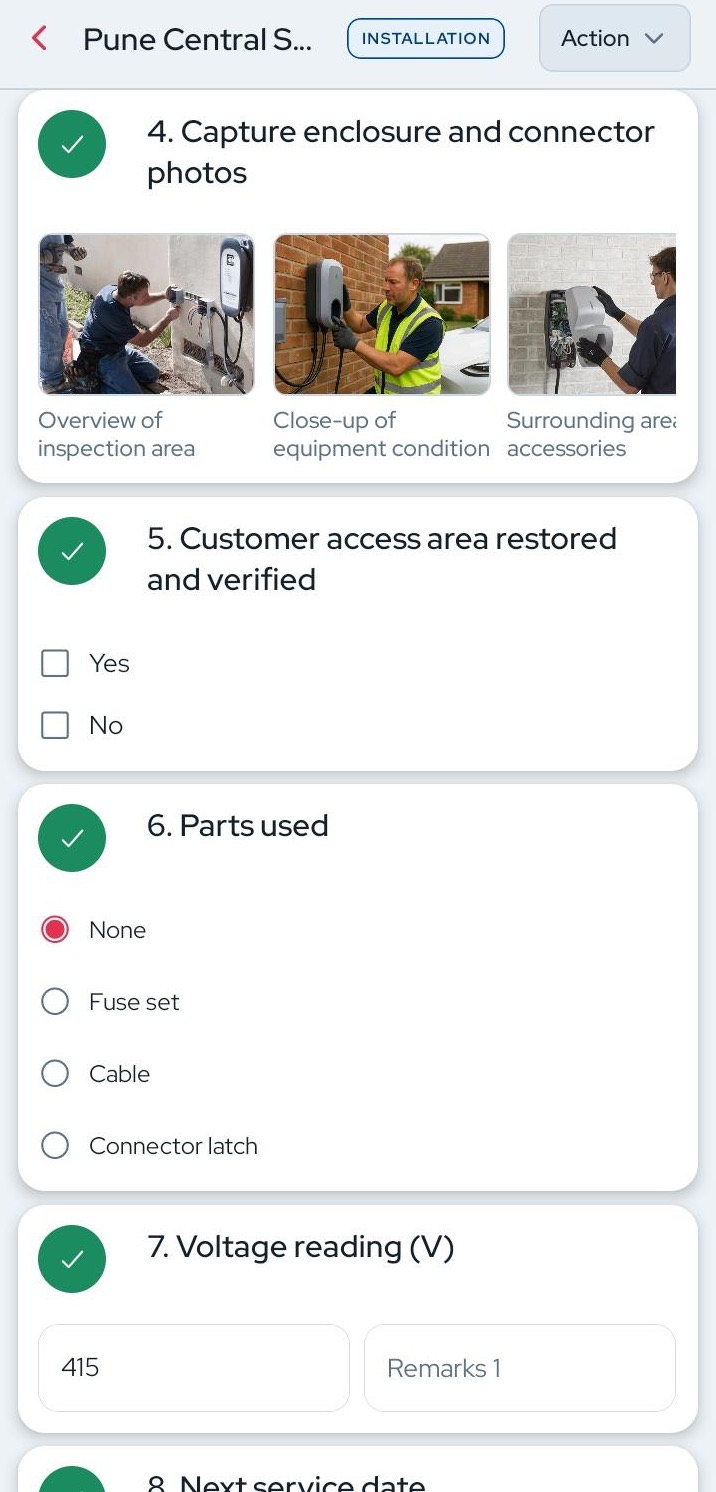
One controlled path from site readiness to go-live.
In the mobile appThe commissioning checklist runs on the phone, so photos, readings and voltage checks are captured on site and timestamped.
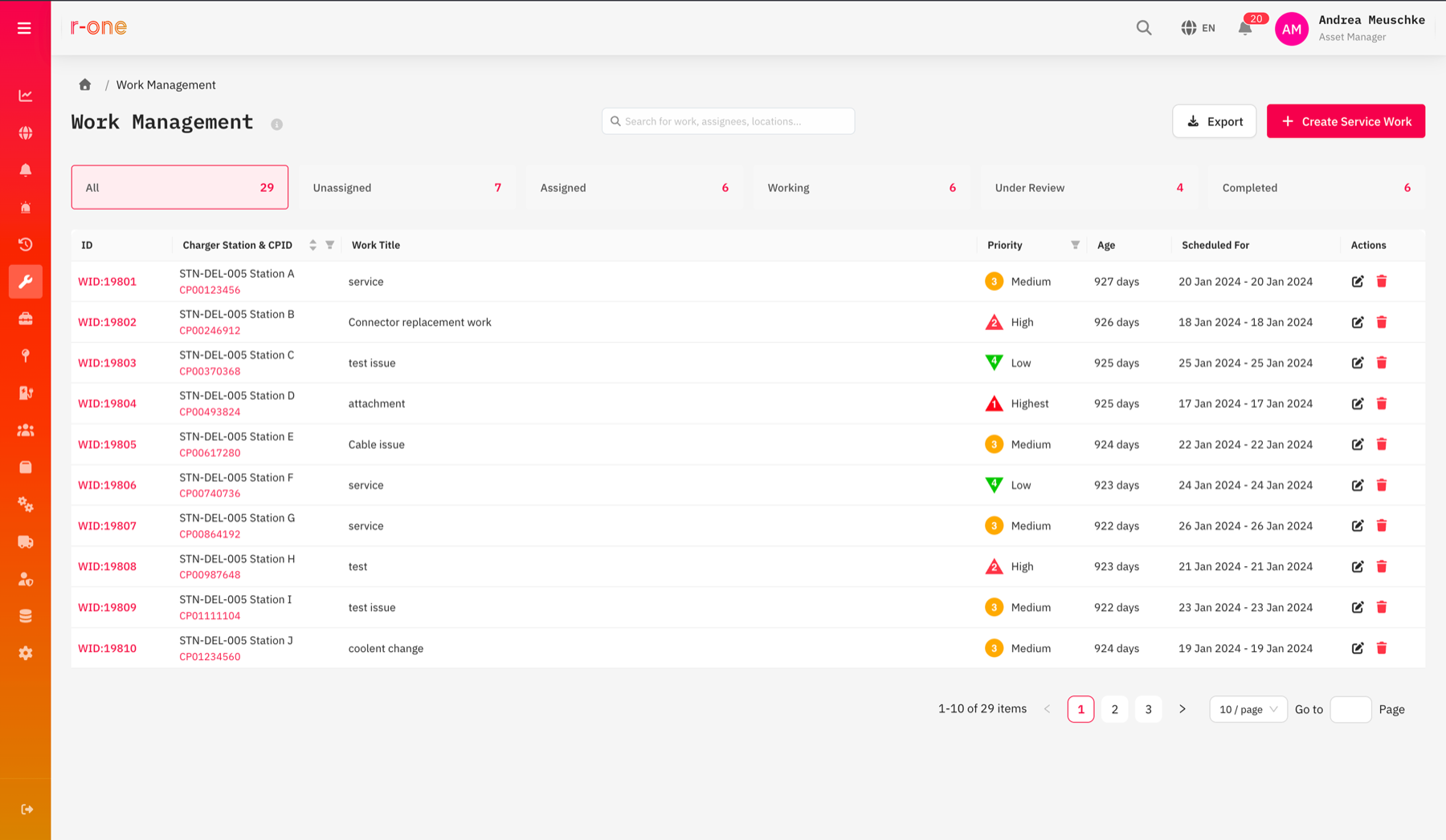
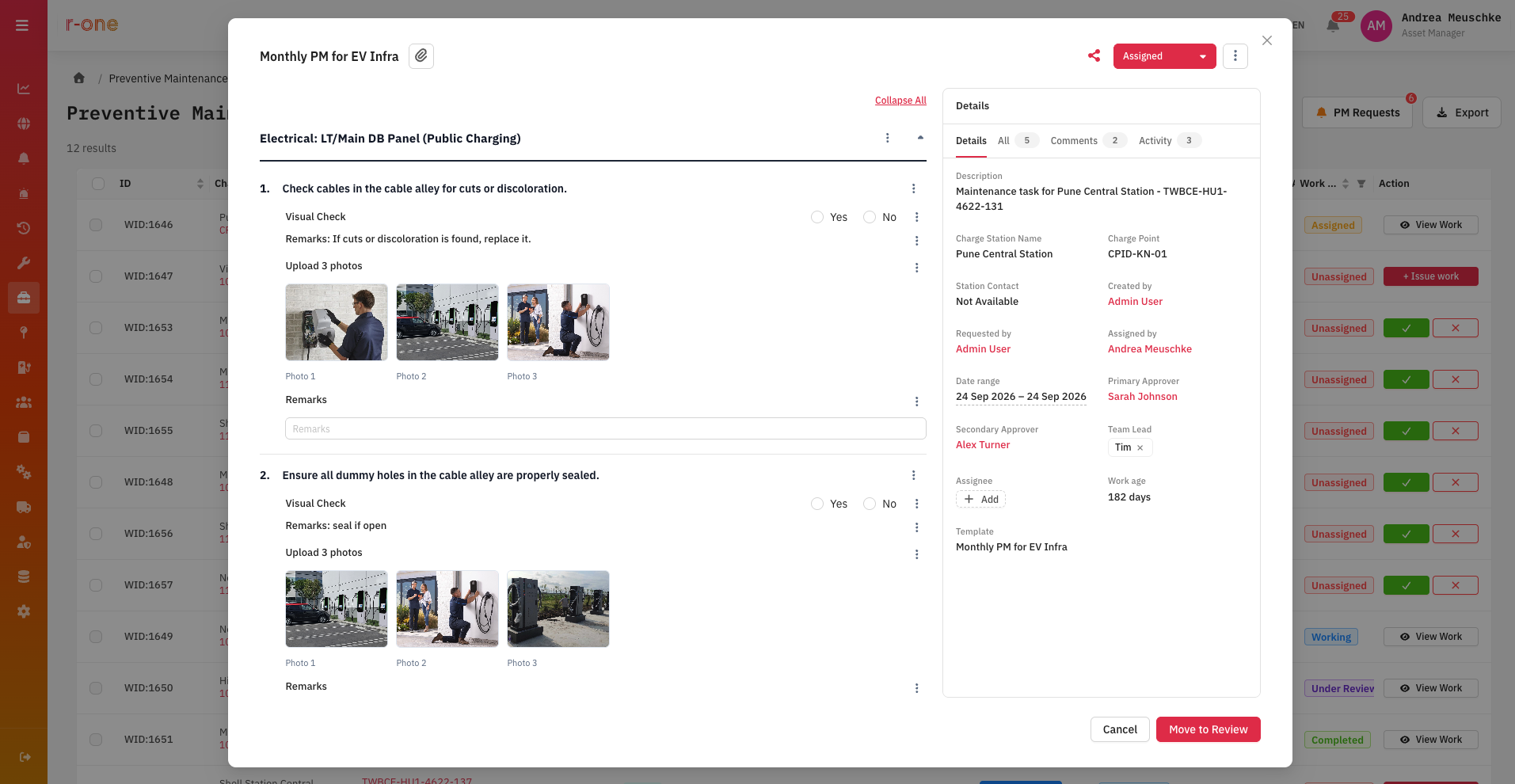
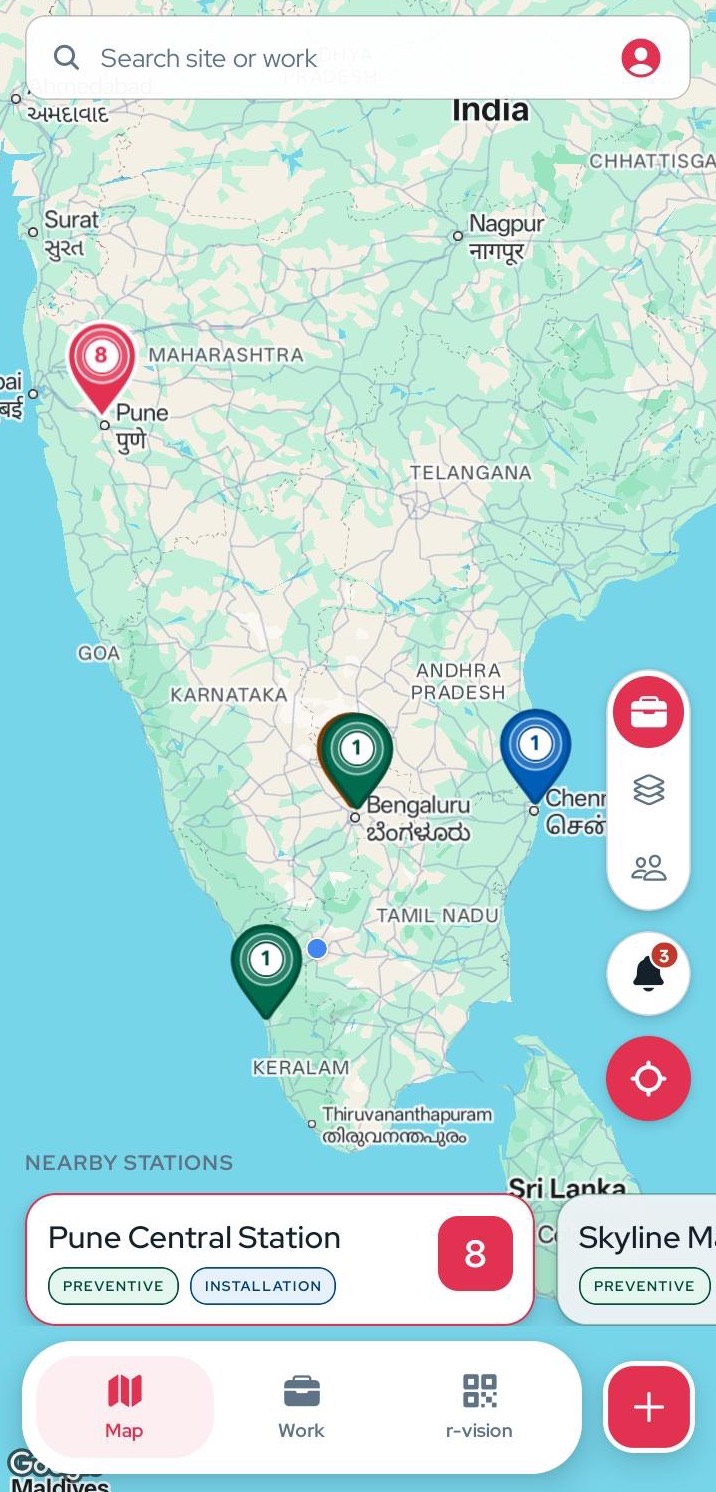
Fix what broke and service what is due, on one work engine.
In the mobile appTechnicians pick up the job with its history, follow the steps and close it on site, online or offline. R-Vision adds the charger's technical and operational data and remote actions to troubleshoot it.
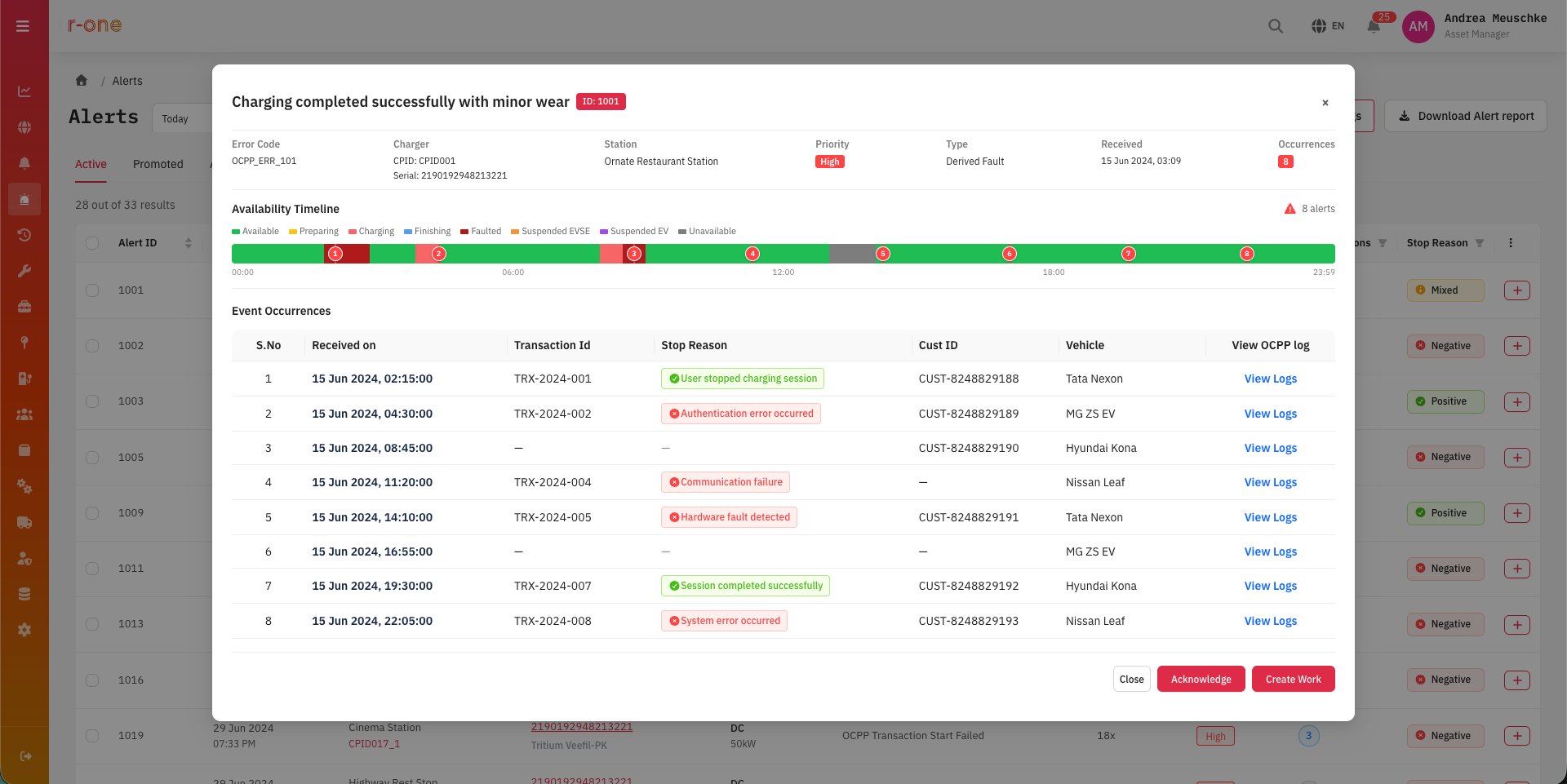
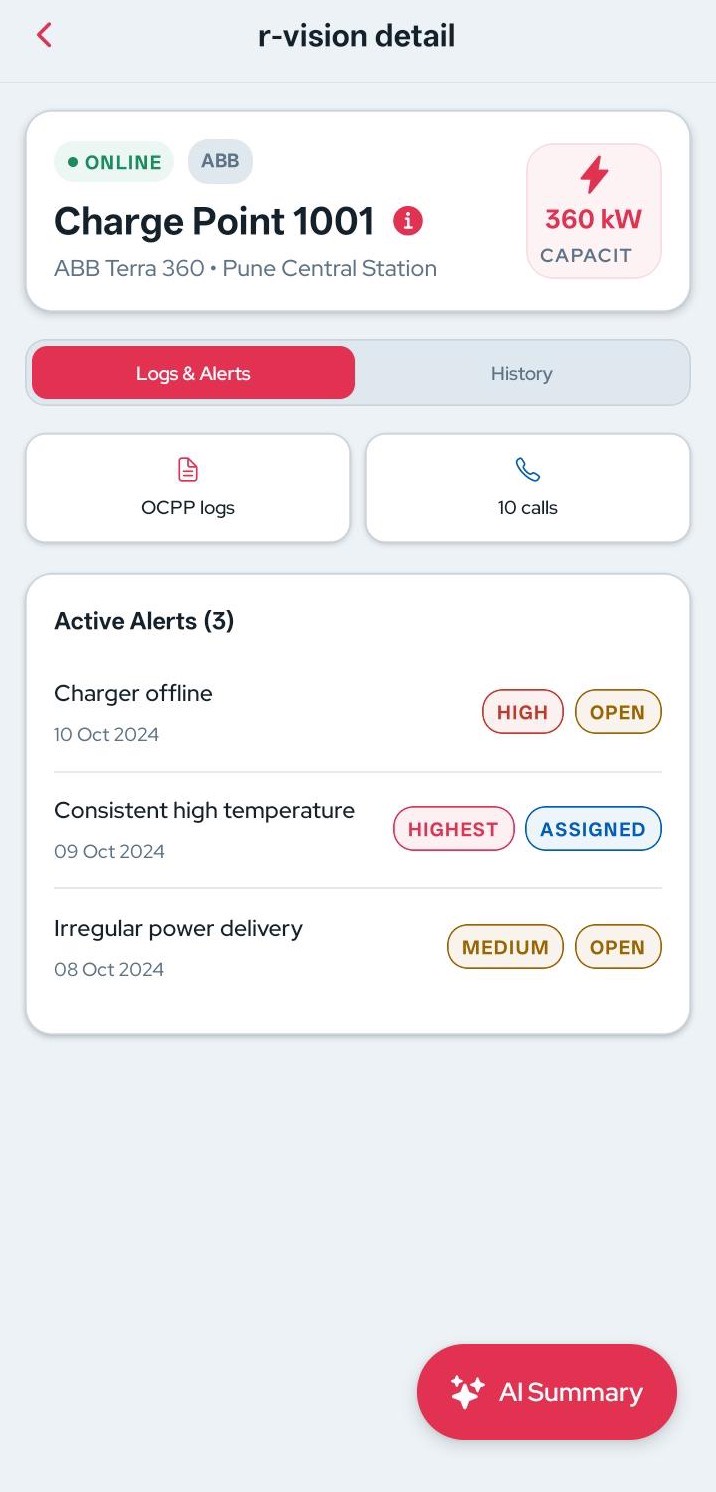
Understand what is failing now, and why.
In the mobile appTechnicians see a charger's active alerts and OCPP logs in R-Vision, and findings and fixes recorded on site attach to the fault.

/Predictive Maintenance
Failure Risk
Know what will fail, weeks before it does, and what to do about it.
In the mobile appThe prescribed fix reaches the technician as a job with the part reserved, and what they find on site feeds back to the model.
A charger can report Available in the CMS while drivers fail to start a session. R-One reads status, telemetry and session behaviour together to catch what the charger does not report.
Faults the charger logs and sends over OCPP.
e.g. Faulted, Unavailable, OEM error codeFaults R-One works out from status, telemetry and session behaviour when the charger logs nothing.
e.g. Shows Available but sessions never start, minimum-energy sessions, repeated interruptionsForward-looking risk from trends and history, with the prescribed fix attached.
e.g. Contactor degradation flagged up to 3 weeks aheadWork orders raised in the planning console land in the technician's task list with fault history, photos and the reserved part attached. Nothing is re-keyed. Photos, readings and sign-off captured in the mobile app write straight back to the asset record as the work happens, online or offline.
Part of the mobile app. It gives the field team asset technical and operational data, plus remote actions to troubleshoot chargers.
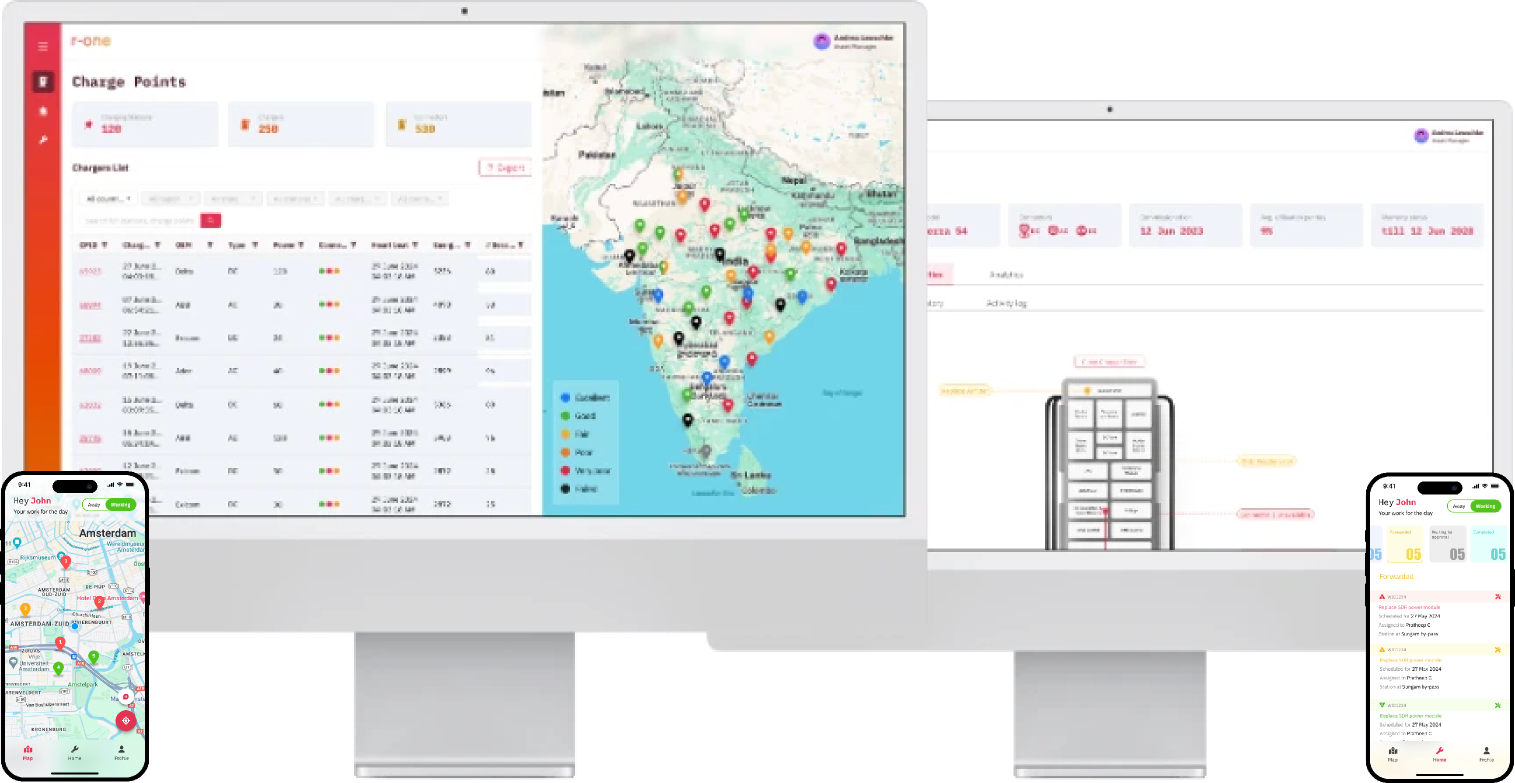
Installation stages, active faults, schedules and predictions all run through the same console, mobile app and evidence model.
Installation stage, active fault, schedule or prediction.
Severity, SLA, age and business impact.
Charger, context, checklist, history and any prescribed action attached.
Technician matched by region, skill and availability.
Parts, tools and site access reserved.
Work completed in the mobile app, online or offline.
Readings, photos, parts and approvals captured on site.
Asset record updated, outcome fed back to the model.
Asset lifecycle structured on the international asset management standard.
Per-charger uptime evidence toward the 99% rapid charger reliability requirement.
Uptime records and audit trail for EU reporting obligations.
Certified information security (TÜV SÜD).

Multi-OEM telemetry across 35+ charger manufacturers.
Best for: Rollouts
Everything in Foundation, plus
Best for: Live operations
Everything in Operations, plus
Best for: 50+ charger, multi-OEM networks
Software that tracks every charger, component and spare part across its life, from installation to maintenance to replacement, and links that record to faults and field work. Iris R-One does this on one record for multi-OEM networks.
Up to 3 weeks. R-One flags the component at risk and when it is expected to fail, early enough to plan the fix, reserve the part and schedule a visit instead of reacting to an outage.
Up to 97% of the chargers R-One predicted would fail went on to fail. Every prediction carries a confidence level, so crews can start with the chargers at highest risk.
Yes. R-One is OEM-agnostic and reads OCPP telemetry from 35+ charger manufacturers, normalising each vendor's error codes into common fault categories.
A fault the charger never logs. R-One works it out from status, telemetry and session behaviour, for example a charger that reports Available while sessions never start or deliver almost no energy.
Prescriptive maintenance goes one step past prediction. After R-One predicts which component is likely to fail and when, it prescribes what to do about it, and turns that action into a remote fix or a work order.
Yes. R-One includes a mobile app for technicians. Jobs arrive with the charger history, the checklist and the reserved parts. Photos, readings, parts used and sign-off are captured on site and update the asset record, and the app keeps working offline and syncs when the connection returns.
R-Vision is the part of the R-One mobile app that gives the field team a charger's technical and operational data on the phone, along with remote actions to troubleshoot it.
R-One calculates true uptime per charger and connector and keeps an evidence trail for every fault and repair, ready for regulator and client reporting.
Yes. Most operators start with inventory and installation, then add maintenance and intelligence on the same asset record.
Share the size and make-up of the charging network, and the walkthrough will show what the asset health index surfaces on it. Demos run about 40 minutes.

